






Big Tech Pours $650 Billion into Partnerships as Nvidia and Sovereign Nations Forge New AI Frontiers
SAN FRANCISCO / NEW DELHI / SINGAPORE — This week marks a pivotal shift in the global tech hierarchy. As the “Big Four” (Alphabet, Amazon, Meta, and Microsoft) commit a staggering $650 billion to AI spending in 2026, the strategy has moved from building internal tools to forming massive, cross-border partnerships that secure every layer of the AI stack.
1. The “Silicon to Service” Vertical Alliances
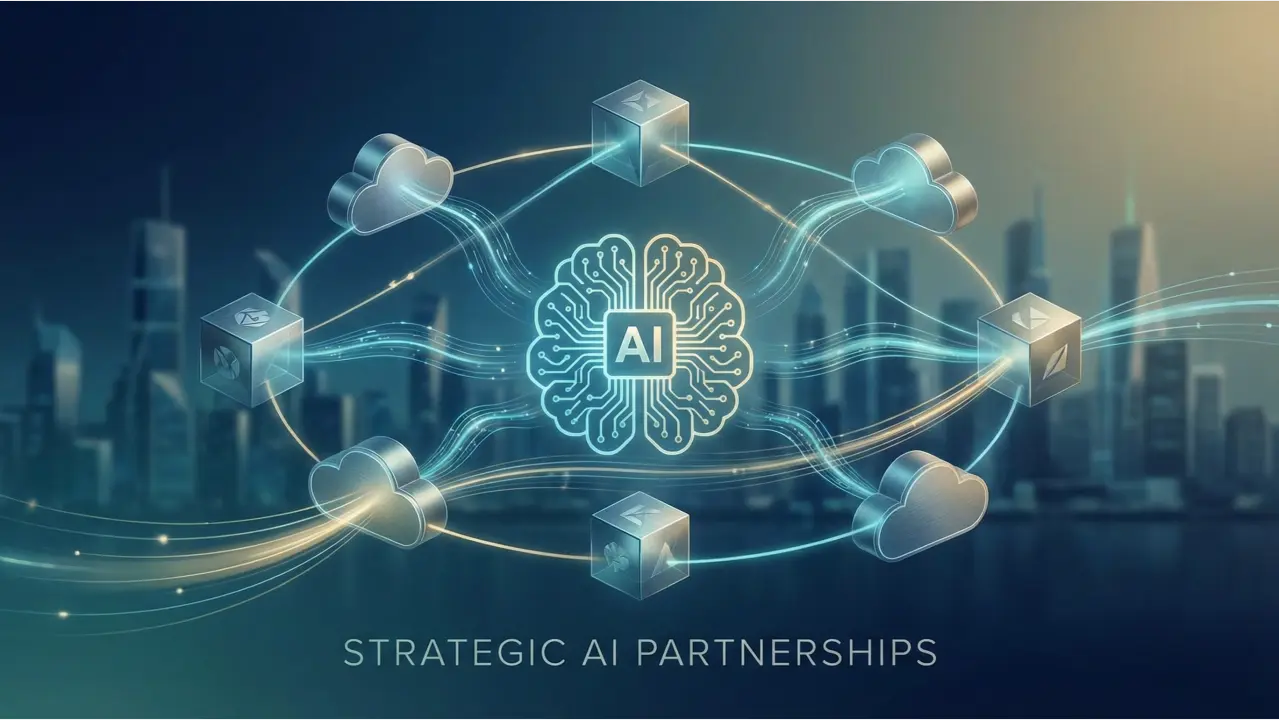
The most significant trend this month is the deepening of “vertical” partnerships, where hardware makers like Nvidia are becoming the central bankers of the AI world.
- Nvidia’s “Neocloud” Strategy: Nvidia has just injected $2 billion into Nebius Group and a similar amount into CoreWeave. These are not just investments; they are “blueprints” for controlling the AI stack. By choosing these “winners,” Nvidia ensures its chips are housed in specialized “AI factories” that bypass traditional cloud bottlenecks.
- The Anthropic Triad: Microsoft, Nvidia, and Anthropic have solidified a three-way alliance. Anthropic has committed $30 billion to Azure compute capacity, while Nvidia and Microsoft are investing $15 billion back into Anthropic. This creates a closed-loop ecosystem for the Claude model family.
- Marvell & the Connectivity Boom: At the OFC 2026 summit this week, Marvell revealed it is working with over 100 ecosystem partners to solve the “connectivity bottleneck,” deploying new 3nm optical DSPs to link global AI data centers.
2. The Rise of “Sovereign AI” Hubs
Nations are now partnering with tech giants to ensure their data and compute power remain within their borders.
- India’s “New Delhi Declaration”: Last month’s AI Impact Summit concluded with 92 countries endorsing a vision for Democratic AI. India is now partnering with global firms to onboard 38,000 GPUs for its “IndiaAI Mission,” focusing on 12 indigenous foundation models to reduce dependence on Western ecosystems.
- Singapore’s $5B Bet: Bridge Data Centres (backed by Bain Capital) announced a S$3–5 billion investment in Singapore this week. The goal is to build 2 GW of “AI-ready” capacity through partnerships with global energy and tech firms, including research into floating hydrogen power for data centers.
- The Japan-India Bridge: In Hyderabad, the T-Hub incubator and Japan’s JETRO have launched a strategic partnership to swap deep-tech startups, focusing on AI-driven pharma and aerospace.
3. Physical AI: The Robotics Frontier
The partnership model is also moving from the cloud to the “edge.”
- Nvidia & Texas Instruments: The two have teamed up to build a sensor fusion system for humanoid robots. By combining TI’s radar with Nvidia’s “Jetson Thor” compute, they are solving the “vision gap” (helping robots navigate glare or fog), with live demos scheduled for GTC 2026 next week.
FN24 Business Analysis: The “Partner-Powered” Growth Flywheel
According to the 2026 Global AI Report released today, “AI Leaders” are now 3.6x more likely to run at high margins because they rely on external collaborators rather than trying to build everything in-house.
However, this consolidation brings risks. As Nvidia-backed “independents” like Nebius surge, some analysts warn of an “AI Lock-in,” where enterprises are forced into specific ecosystems just to get access to the latest silicon.