






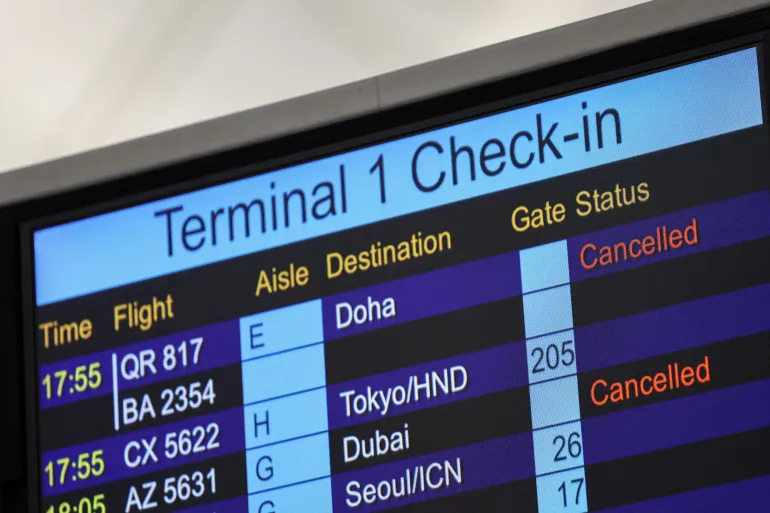


“Unprecedented” Aviation Shutdown Enters Day 5; Repatriation Flights Begin Amid Ruins
DUBAI / LONDON / NEW DELHI — The “engine room” of global air travel has effectively stalled. For the fifth consecutive day, the Middle East is facing the most acute aviation shock since the 2020 pandemic. With nearly 20,000 flights cancelled since the start of the conflict on February 28, major international hubs like Dubai, Doha, and Abu Dhabi are struggling under the weight of hundreds of thousands of stranded passengers.
1. The Hubs in the Crosshairs
What makes this crisis unique—and uniquely dangerous—is that the world’s busiest international transit points were not just closed; they were directly impacted.
- Dubai (DXB): Authorities confirmed strikes at the airport earlier this week. While limited operations resumed on March 2, the world’s busiest international hub is operating at less than 35% capacity.
- Doha (DOH) & Abu Dhabi (AUH): Airspace over Qatar and the UAE remains largely restricted. Qatar Airways has suspended nearly its entire network, while Etihad has halted all scheduled commercial departures through March 5.
- The Humanitarian Toll: From Bali to London, families are sleeping on terminal floors. In Dubai alone, over 20,000 affected passengers have been moved to temporary hotel accommodations as food supplies at airports begin to dwindle.
2. The Great Reroute: A “Gaping Hole” in the Sky
Airlines are now treating the Middle East as a “black hole,” forcing them into costly and exhausting alternative paths.
- The “Rome Stop”: Air India and other carriers heading to the US and Europe are now making technical stops in Rome (Fiumicino) to refuel, as the direct northern corridor over Iraq and Iran is blocked.
- Fuel & Time Costs: Rerouting around the conflict zone is adding between 2 to 5 hours to long-haul flights, sending jet fuel consumption—and ticket prices—soaring.
- Airspace Pressure: Flights are being funneled into congested corridors over Egypt and Saudi Arabia, leading to “traffic jams” in the sky and further delays.
3. Operation Homecoming: Repatriation Efforts
Despite the chaos, a massive international effort is underway to bring citizens home.
- Indian Airlift: The Government of India has launched a massive operation, with Air India, IndiGo, and Akasa Air running 58 special flights on March 4 and 5 to evacuate citizens from Dubai, Fujairah, and Muscat.
- European Charters: British and French governments have begun chartering private aircraft to evacuate vulnerable nationals, with the first flights departing Muscat on Wednesday evening.
- Lufthansa Evacuation: A special Airbus A340-300 was dispatched to Oman on the night of March 4 to repatriate German citizens.
Expert Analysis: “This is not a routine delay,” says Hassan Shahidi, CEO of the Flight Safety Foundation. “This is a conflict zone airspace story. Even when the missiles stop, the ‘displaced aircraft’ effect—where planes and crews are in the wrong corner of the world—will take weeks to resolve.”
FN24 Traveller’s Essential Advice
- Do Not Go to the Airport: Most airlines are operating a strict “No Ticket, No Entry” policy at hubs like DXB. Only head to the airport if you have a confirmed departure time sent directly to you in the last 4-6 hours.
- Shelter in Place: For those in Gulf hotels, embassies are advising staying put. Roadways to airports are increasingly clogged and border checkpoints are experiencing 12-hour waits.
- Flexible Rebooking: Major carriers (BA, Emirates, Qatar) are offering free rebooking for travel through March 15-31.